

According to an IEC analysis of data from the U.S. Bureau of Labor Statistics’ 2025 Union Members Summary released February 18, the number of construction industry workers choosing not to belong to a union has reached an all-time high, underscoring the continued dominance of the merit shop employment model at a time when the industry faces significant economic and workforce challenges.
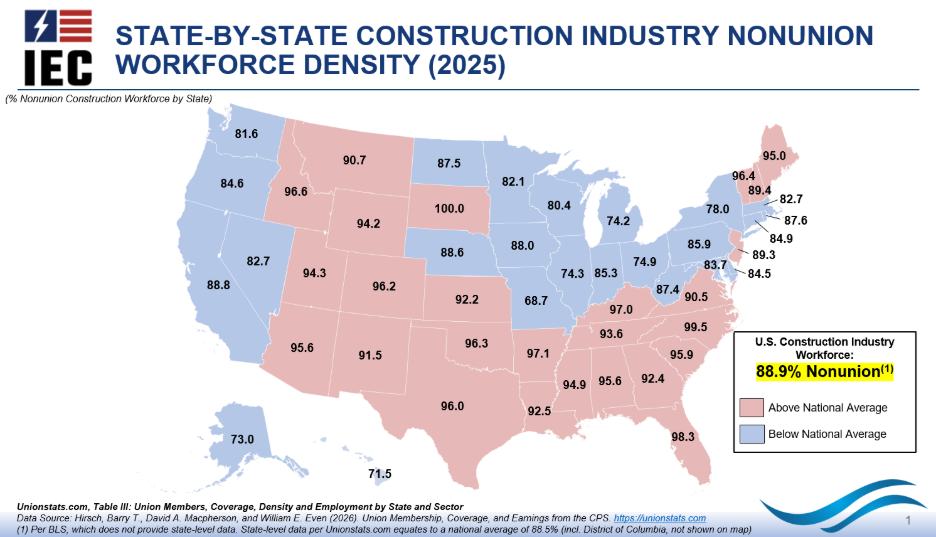
Of the 9 million people employed in the U.S construction industry, 8,005,000 are not union members. An increase of 27,000 workers between 2024 and 2025 marks the fifth consecutive year of growth for the construction industry’s nonunion workforce following the disruption caused by the COVID-19 pandemic in 2020. In 2025, nearly 89% of the U.S. construction workforce was nonunion.
While union membership in construction rose modestly from a record low of 10.3% in 2024 to 11.06% in 2025—reflecting a gain of 79,000 union members—overall industry employment growth continues to be driven overwhelmingly by merit shop employers and workers.
In 2025, 25 states have construction industry union membership rates below the national rate of 11.1%.
“The data make clear that construction professionals continue to choose flexible, merit-based workplaces where advancement is tied to skills, performance and opportunity,” IEC Federal Lobbyist Ben Brubeck said. “At a time when the industry needs to maximize participation to meet demand, federal policies should expand opportunity, not restrict it.”
IEC and industry leaders warn that Biden and Trump administration policies favoring government-mandated project labor agreements and other state and local government regulations that steer taxpayer-funded work only to union firms risk limiting competition, reducing the available workforce, and increasing costs for taxpayers. With contractors already confronting a projected workforce shortage of 349,000 workers in 2026, along with rising material costs and supply chain volatility, policymakers should be creating the conditions for robust competition from the broadest possible talent pool of contractors and workers.
A 2024 IEC report found that merit shop construction—where employees are hired based on qualifications, can pursue continuous skills development, and advance according to performance—has enabled the industry to respond to surging demand for infrastructure, energy, and manufacturing projects nationwide.
Ensuring that all qualified contractors and craft professionals can compete for federal and federally assisted construction contracts is essential to delivering projects efficiently and cost-effectively.
“Federal investments in America’s infrastructure should be implemented in a way that encourages full and open competition,” Brubeck said. “IEC estimates that America needs 80,000 new electricians per year to meet industry demand, so removing barriers that exclude the vast majority of the construction workforce will help address labor shortages, save taxpayers at least $10 billion a year, and ensure local small businesses and workers have a fair opportunity to compete to rebuild their communities.”
As policymakers deliberate the future of government-mandated PLAs and other exclusionary policies, IEC continues to advocate for policies that preserve worker choice, promote workforce development, and allow all segments of the construction industry to help build America’s infrastructure and communities.
IEC members and industry stakeholders are encouraged to take action via this IEC grassroots campaign, send an email to the Trump administration, and ask it to protect taxpayers and 9 out of ten construction industry workers who choose not to belong to a union by repealing the Biden administration’s harmful pro-PLA policy.
Recommended Reading: A Washington Post column provides more insights on the BLS data and the state of America’s unions.