
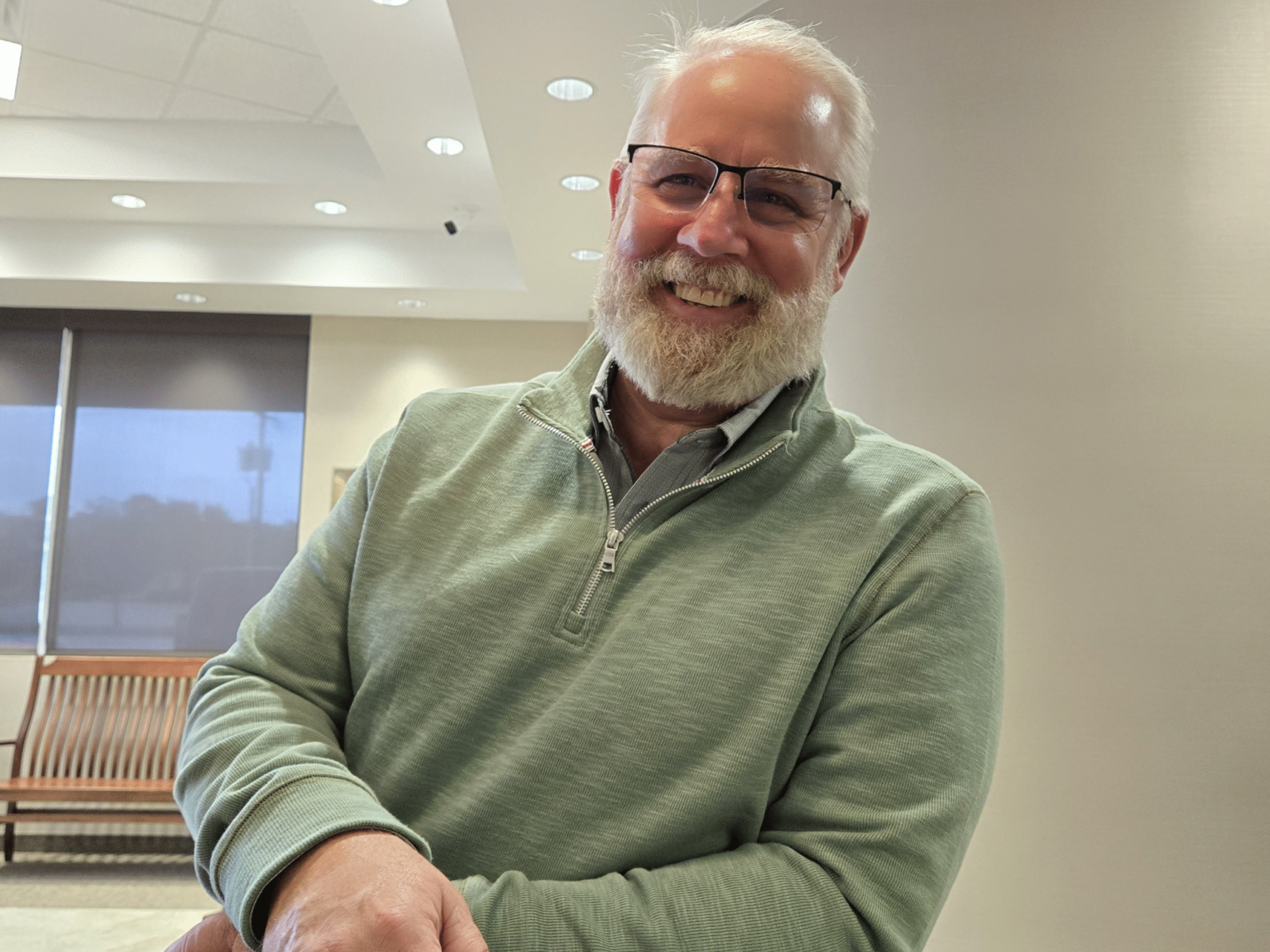
If someone were to describe the ‘typical’ president and CEO of a successful medium-sized electrical contracting company, it may not be someone with a background like Brian Brinkmann of Tutor Electrical Service, Inc. Tutor Electrical is a full-service electrical contracting company based in Mansfield, TX, in the heart of the Dallas-Fort Worth Metroplex, and an active member of IEC Fort Worth.
Brian earned five degrees, including two post-graduate degrees — a master of divinity in biblical languages and a master of science in counseling psychology.
“The most important ‘degree’ I have, though, is the post-secondary technical certificate in industrial electricity I received at the completion of my four-year electrical apprenticeship training program, which was hosted by a community college,” Brian says. “That certificate was a ticket to a trade that has provided a comfortable lifestyle for my family and I for over 35 years and it funded the four other degrees without the need for student loans.”
Brian believes that each avenue of learning he took helped him become the electrician, businessman, and person he is today.
First Steps to His Future
After high school, Brian planned to attend Wright State University in Ohio.
“I was planning on doing bioengineering, biochemistry,” he says. “I’d done a little thing with Monsanto during the summer on recombinant DNA, and I thought that was cool.”
But then his father got a transfer to Patrick Air Force base in Florida and asked Brian if he wanted to move to the sunshine state.
“Hmmmm, Ohio or Florida?” he remembers. “It didn’t take long for me to say yes and buy a surfboard and motorcycle.”
When Brian started school there instead of at Wright State, they didn’t recognize his out-of-state advanced honors classes, so he had to begin with the basics. For Brian, that included electives like handball, racquetball, and weight-lifting.
 “It was cheaper than joining a gym,” he jokes.
He also worked at Walgreens part-time while attending college. The retail giant invited him to enter their management training program. He elected to quit school and follow that path. Retail ended up not being the right fit, and he looked for a career that offered him the opportunity to work with his hands. He saw an ad from the Florida Workforce Commission seeking electrical apprentice candidates.
“In 1990, after an eight-year career in retail management with Walgreens, I entered and completed a four-year electrical apprenticeship training program in Brevard County, Florida,” he states. “After earning a journeyman electrician license, I worked as a service technician, then as a project foreman / superintendent, successfully completing several large commercial and institutional projects for my employer.”
That experience provided Brian with extreme satisfaction in a job well done. He says while Walgreens measured success by numbers on paper, electrical work provided long-standing validation.
“When I was in Florida recently, I drove by and saw that my first job is still there today,” he offers. “I could say, ‘I wired those light poles.’ There’s just something about legacy and seeing something you accomplished stand the test of time.”
Where Faith Meets the Trade
The work was great but as a man of faith, Brian felt that God was closing the door on the electrical field and that his next step was a full-time ministry position. He relocated to Fort Worth in 1997 to attend Southwestern Baptist Theological Seminary and simultaneously joined Tutor Electrical Service.
“I thought at the time that when I finished my time in seminary that I would become a full-time pastor of a church,” Brian says. “When the seminary sent out notice of my availability upon completion of my program, I had 67 requests for my resume and only one was for a full-time position. It was in Guam. The others were from very small churches which couldn’t afford full-time ministers. They saw I was an electrician and figured I could pay my own way.”
He accepted a position at a Fort Worth area church with just 35 members, Wednesday and Sunday hours, and a lot of independence — and he continued to work and grow at Tutor. He was at that church about 10 years, learning and growing himself.
During this time, his newly licensed daughter Sarah was tragically killed in an automobile crash. Going to a friend’s church which offered a grief support program provided his next opportunity.
“I felt I needed a change, got involved helping with the grief support program, and actually ended up taking over that program as facilitator for about five years,” Brian explains. “That’s when I went back for my second master’s degree and became a licensed professional counselor. So, now, ministry for me is actually counseling. I’m on call a couple nights a week and if somebody’s in trouble, I get a call to help.”
When Sarah died, he also learned more about the IEC family.
“I have a special place in my heart for the people of IEC, who rallied behind me and my family with financial and emotional support when we lost Sarah in 2009,” Brian says. “All Bobby Tutor had to do was send out a single email and support flooded in from IEC National and chapters around the country. I learned what it meant to be a part of the IEC family on that day, and I will never be able to repay the debt of gratitude I hold.”
Grounded at Tutor Electrical
“I am a product of those who poured into me the knowledge and skills needed to succeed in this trade and offered me opportunities to grow into increasingly important and demanding roles along the way,” says Brian.
A big part of that has been Tutor Electrical Service. Founded in 1993 by Bobby and Diana Tutor with one truck and a pager, it has grown into a multi-million-dollar construction sales and service company with more than fifty full-time employees.
“Our Service Department has over a dozen fully outfitted vehicles, including a bucket truck, and we serve primarily industrial manufacturing facilities and commercial properties,” Brian describes. “Our Construction Department engages in both competitive bid, and design-build commercial new construction and remodel opportunities across several markets including municipal, public safety, healthcare including hospital, education including K-12 and higher ed, automotive, assisted living, religious, entertainment, financial services, manufacturing, and distribution, among others.”
Bobby originally provided the anchor with IEC, serving as an IEC National president, an IEC of Texas Executive Committee member, and IEC Fort Worth president.
“Bobby has given me free reign to do a lot of things,” Brian says. “It’s his company, he owns it, but he’s allowed me to make a lot of decisions, including some really questionable ones, but we’ve learned how to grow into a successful medium-sized contracting business. I appreciate that, and I can’t hold all that I’ve learned inside. That’s selfish. I cherish the opportunities to mentor others and to give back from what I’ve learned along the way.
“What we’re doing at Tutor Electric right now is preparing for the next generation of leadership,” Brian adds. “In fact, our tagline is: Honoring Our Legacy, Powering the Future. I want to leave this company even better than I found it.”
Making an Impact
One way Brian passes along what he’s learned over time is through his work on the IEC National Professional Development Committee, which he joined in 2023. This is an advisory committee that directs IEC’s management and continuing education programs including online training courses, and other programs that assist IEC chapters in providing management and continuing education to the members.
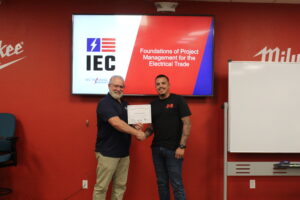
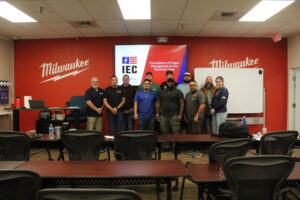 A program that has been gaining traction and is near and dear to Brian’s heart is the Foundations of Project Management (PM) program. This experiential skill development program is targeted toward those who are at the beginning of their PM journeys such as entry-level PMs (less than five years of experience), project engineers or administrators, estimators, and field personnel who are stepping into what are likely to be their first managerial roles.
“The directive I was given was to create a foundational program that would define project management as a concept, clarify the role and responsibilities of the project manager on the project team, identify and begin to develop hard and soft skills that a project manager should possess, and introduce tools and processes that a project manager will use throughout the four stages of a project’s life cycle: acquisition and initiation, planning, execution, and close-out.”
The origins of the IEC program date back to 2020, when IEC desired to produce an entry-level project management development program specific to the electrical trade. IEC 2020 President Candy Branham began looking for someone to author the program material and Brian’s name came up. Bobby asked Brian if he would be willing, saying ‘they’re just looking for someone to write it,’ and Brian agreed.
As a graduate of the former 80-hour, IEC and Associated Builders and Contractors (ABC) Project Management for Electrical and Mechanical Contractors program led by Dr. Kirk Alter at Purdue University, Brian understood the need for developing a basic skill-development pathway for those just starting the journey into project management.
“I learned so much from Dr. Alter, and how much I didn’t know as well,” Brian says. “Much of what he exposed us to was way over my head, and I was vice president of Tutor Electric when I attended! The IEC program, while experiential like Dr. Alter’s program, is structured at a more fundamental level, and is targeted at those just learning about management generally, and project management in the electrical trade specifically.”
Once Brian joined the team, he was invited to attend a meeting in Denver where the committee would be meeting.
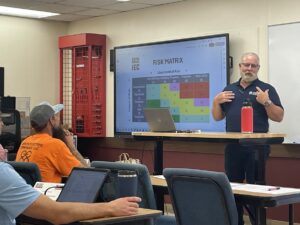 “I sat in a room in Denver and just wrote, while everybody else moved in and out committed to other things at the convention,” Brian remembers. “They liked what I wrote, the concepts were approved, and the next step was to put the program out there.”
In the next meeting, the group was struggling with how to do that. IEC sponsor and leader in producing quality training materials, ATP, was present and ATP’s Cathy Scruggs spoke out and said, ‘we’ve got to get this ball rolling.’
“So, I stood up, approached their room-wide whiteboard, and drew four quadrants,” Brian says. “I said these are the four phases of a project life cycle, so why don’t we build it around that? They liked that approach, so I went back to writing and presented it at SPARK in Louisville in 2022. They selected me to be the presenter, and we conducted a beta test less than a year later in Fort Worth. As we move into 2026, we’re entering our third full year of offering this well-received program.”
In 2025, IEC presented Foundations of Project Management at seven chapter locations: Northern Ohio, Greater Charlotte, Atlanta / Georgia, Florida East Coast, El Paso, Oklahoma City, and Arizona. Brian facilitated them all.
Brian says the program revolves around a set syllabus, but each group has its own flavor depending upon the attendee mix, number of participants, etc. For example, a smaller number of attendees allows them to get to know each other better and identify skillsets that they really want or need to develop.
“I tell each group at the very beginning, and this is why I think it works so well, is that I’m not there to just give them three days’ worth of content,” Brian explains. “The idea is for us to interact for three days and have them leave there different than when they came in. One of my favorite offerings this past year was at IEC Florida East Coast. It was the first time we did a Thursday / Friday / Saturday schedule and Bob Terry, executive director, had a pretty good crowd. But there were also some business owners in there. And that was cool, because when we would start talking, I could see the business owners and their guys kind of huddling up, saying we need to start doing this or that. It was pretty cool to me to see how the owners really bought into it and how much they thought they could improve their organizations.”
Brian believes another key to the program’s success is that he shares his own stories and experiences, including his mistakes and ultimate fixes. This improves interaction since he tries to make light of the fact that project management is an imperfect thing.
 “There are two really broad analogies that I use as a structure to teach within,” Brian shares. “The first one is the analogy of the bucket. The bucket represents the total contract value of a job — and that’s all you have. The goal is to manage the contents of the bucket because you can’t put anything else into it, you can’t drill a hole in the bottom of it, etc. This provides a great framework to explain job costing for example.”
When he talks about risk management, he uses one of his favorite analogies and teaches them how to be ‘fruit pickers.’ There’s low-hanging fruit, and he talks about his experiences as a foreman and the low-hanging fruit of controlling cost by not paying people to drive to and from work, or not paying them to sit down for 20 minutes instead of 15.
Then he offers the fruit in the middle of the tree, where it’s a little bit harder to find, and how a project manager can help a foreman look at things like means and methods, products they’re using, how they’re installing, diversity of the workforce and pairing the correct workers together.
“It’s a little bit harder to find that fruit, but it pays off a little bit more,” Brian says. “Then I challenge the PMs to really look for the golden fruit at the top of the tree. That’s very rare to find, but when you do, you can make a ton of extra money. And if you don’t, you’ll lose a ton of extra money.”
He cites one example of a situation that shouldn’t happen but likely does for many contractors. While attending a design meeting on one of their jobs, he saw out his window a worker walking from the job site to the job trailer. Then he started walking back carrying one roll of flexible conduit. A bit later, he saw another worker take the same long walk and pick up one roll of wire. He learned the reason why they had to station the job trailer so far away from the work being done, but questioned why they were taking that walk multiple times in the day. Why not take all you need over at once?
“These guys are wasting a lot of your labor time walking back and forth,” Brian noted to the foreman.
When he dug into this particular situation, they realized that the guy in the field wasn’t supposed to even need some of those items. In the estimate, the fixture whips they were using the material to assemble were quoted as a pre-manufactured item to come with the fixtures. Brian says it was a breakdown in communication between the project manager and the guy in the field. But it needed to be fixed.
“The participants in the IEC project management program are at the beginning of that journey as project managers,” Brian reminds. “Or, they’re coming into big organizations out of college with zero field experience and they have no idea what any of this means. I am very intentional about connecting the dots, and by day three you start to see recognition as we tie everything together. Sharing examples helps.”
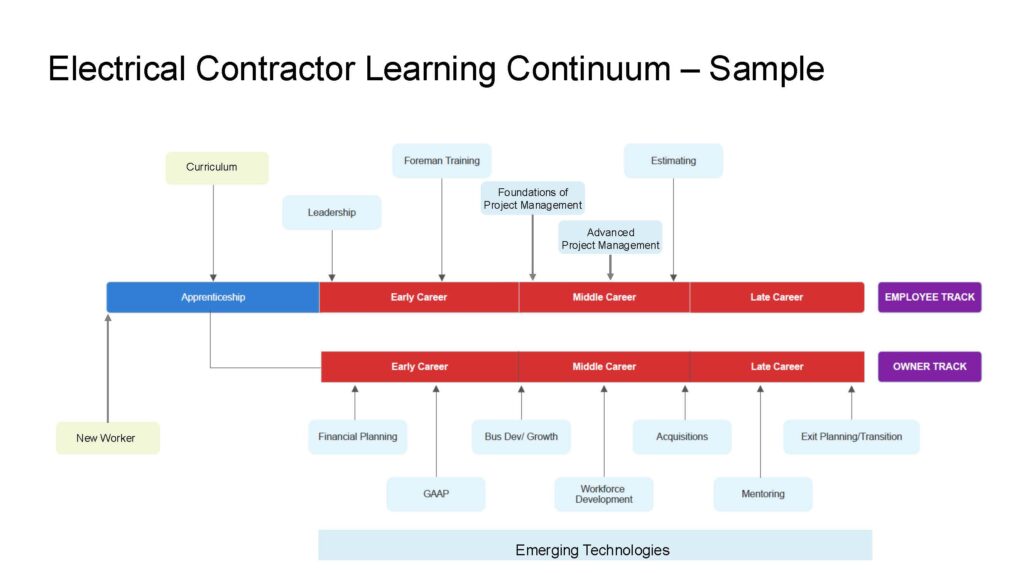
The Professional Development Committee is on target to expand the Fundamentals of Project Management program with eight offerings expected in 2026, find and train additional instructors, launch its Foreman Training program modeled after the PM progam, develop its next professional development offering, and identify 2027 course development based on contractor needs — maybe estimating or financial planning. The committee also is committed to developing a library of third-party resources and webinars to support the contractor learning continuum.
The learning curriculum plots out educational needs along the electrical contractor career continuum from apprentice to early career, middle career, late career in two tracks: employee and owner. See graphic.
Brian’s Advice for Future Electricians…
“I speak regularly with high school students about the lifelong opportunities afforded to people in the building trades in general, and in the electrical trade in particular,” he says. “As a huge fan of Mike Rowe, I echo his sentiment that while a college degree may be the only path to certain careers like pilots, doctors, or engineers, it is not the only path for EVERY career, nor is it the best path for MOST careers. I tell them about my degrees and my path, and I assure them they don’t have to have it all figured out right now.
“Then I talk about the student loan crisis, how much it costs to go to college, how you can live at home and get a job, or I’ll pay you up to $20 an hour as a first-year apprentice. At the end of our four-year program, you can make between $30 and $40 an hour, which could be 15 bucks an hour more than the kid coming out of college. I share statistics. I share stories. And I encourage them. I still run into students telling me that their moms and the school counselors keep telling them they have to go to college and that they really don’t want to do that. I’m not going to tell them to disobey their mamas, but I give them the statistics to help them have conversations.”
Brian’s career path is an example of lifelong learning, and his guidance is given freely out of support for those considering electrical careers and out of love for the industry.