
Sometimes, things just click.
According to all involved with the 2025 Emerging Leaders cohort — and all who experienced their Industry Impact Project presentation at SPARK 2025 and beyond — that was most definitely the case with the 2025 team of high-potential individuals who participated in the program to bolster their leadership skills and experience.
What began as nine individuals seeking knowledge and growth for themselves became a nine-member team committed fully to encouraging the younger generation to consider an electrical career.
The Project’s Origins
Artists stare at a blank canvas. Writers look at the blank screen or page. Electricians evaluate the physical space while viewing the wiring diagram.
For the Emerging Leaders, they wrestled with a seemingly overwhelming task — develop a project designed to address real-work challenges in the industry. And, do so in time to present the project at SPARK. They began to tackle this challenge at their first in-person meeting in Cincinnati, OH, in April 2025; SPARK was in September 2025.
Along with members of the IEC Emerging Leaders Committee, many former Emerging Leaders themselves, they sat together in a room and brainstormed. They knew that perhaps the biggest challenge faced across the country is a shortage of qualified electricians ready to fill the gap as more current electricians reach retirement age.
“Our cohort wanted to create something that would outlive the program, something that would support the industry long after we graduated,” says CJ Billings, IEC Chesapeake. “As we discussed, one thing that kept coming up was that the talent pipeline was shrinking. We realized that to reach kids we need to meet them where they already are.”
“The committee gave us some guidelines to kind of help steer us in a direction, but they didn’t tell us what to do for a project,” says Justin Graber, IEC Florida West Coast. “We brainstormed for hours, spit balling different things. Gamification popped up, and that resonated with most of us there. We agreed, yes, let’s focus on utilizing gamification in one form or another. We just stuck with that. We didn’t really second-guess ourselves, and we just kept moving forward.”
“We had many ideas and it was very important to us to do something that had an impact that we could calculate. We wanted actual, tangible results,” remembers Indiana De Los Santos, Atlanta Chapter IEC. “We went through a lot of options, but we kept going back to the same thing, gamification, Minecraft. But, well, how are we going to do this? Is this even feasible? Minecraft won’t even look our way, as we’re just nine people trying to do this, right?”
Indiana says they kept reiterating among themselves how they wanted the young audience to take a look at going into the trades as an option to college and being completely in-debt at the time that you finish.
“Yes, it’s heavy work, physical work, but it can work for you,” finishes Indiana. “Monetarily, it makes sense. You will receive your return of investment on it. That’s how we decided to go for it and landed on the idea of a website, because it would give us tangible results; we would be able to track the visits. And, of course, the gamification part. Let’s go for the middle schoolers, let’s go for the early ages when they’re still deciding what they want to do.”
“We wanted to meet the younger generation where they’re at and that’s in digital spaces,” says Heather Folsom, IEC Dallas. “We threw around a lot of different ideas. Social media. Internet. Different campaigns. Then we started talking about gaming, and our first idea was to create a game on our own. As we talked about the logistics of that, the cost of that, the time expense needed for something like that, that led us down the path of what can we utilize that’s already here?
“That’s where Minecraft came in, because it’s wildly popular and kids have been playing this game for 10 years. You also see young adults that have a history of playing Minecraft, including a couple on our team,” Heather continues. “The Minecraft education version has been widely used within schools and STEM education for many years. We wanted to maximize exposure on a platform that already had reputation in the educational realm, and would not be an expense for educators or families.”
The cohort decided to create a module for Minecraft Education to get middle schoolers excited about basic electrical concepts and introduce them to the fun and fascinating electrical world.
“I I have kids that play Minecraft, and I knew there were worlds,” Heather continues. “We had discussion flowing back and forth and a couple of people on our team who were very experienced felt that we could create a world.”
That led to discussion of how best to push out this world they’d be creating. Cohort member Heather Creech has a background in STEM education. She felt they could use Minecraft redstone circuits to simulate electrical circuits.
“Heather kept us focused on tying the game into educational aspects and to push the project out in a more formal manner that would have a lot of credibility,” says Heather Folsom. “We created a lesson plan that would walk teachers or STEM educators through the game that we created. We could show them a lesson plan that’s already designed to meet all the requirements for different educational aspects and they would feel confident that they had enough there to work with to fit their program.”
The excitement in the room was high that day in Cincinnati and the group came to the realization that they could do this. Their challenge was to then take their big ideas and work through the logistics. How do we build the module? How do we scale our big ideas for the timeline of the project? How do we succeed with no budget? How do we manage the work when each of us is employed full time and have families?
“It became very exciting to know that we had numerous people in our cohort that came with specific strengths, where we could piece things together to make a final product that we’re really proud of,” Heather Folsom says.
The Project Grew
The team got to work. They broke into teams — game development, marketing, education — to move pieces of the whole forward. Regular virtual meetings were scheduled in between the in-person opportunities to meet. Emails were sent and even became overwhelming at times. Additional ideas popped up. More discussions were held and more resources were developed.
Heather Creech contacted a former teaching colleague and was able to bring the game to a fourth and fifth grade class to beta test. Hance Joiner, former Emerging Leader and workforce development coordinator at IEC Georgia shared the QR code to the game at various regional skills challenges across the state where he was meeting students. Feedback was encouraging, and the cohort continued its efforts.
As of the end of December, the 2025 Emerging Leaders Industry Impact Project website — built for ‘students, educators, parents, and anyone curious about careers in the electrical trade’ — contained:

Powering the Future Video: an electrical apprentice provides information on how the program set him up for success for years to come.
Instructions for Connection: those interested in pursuing the IEC Apprenticeship Program can find their chapter to get started in careers.
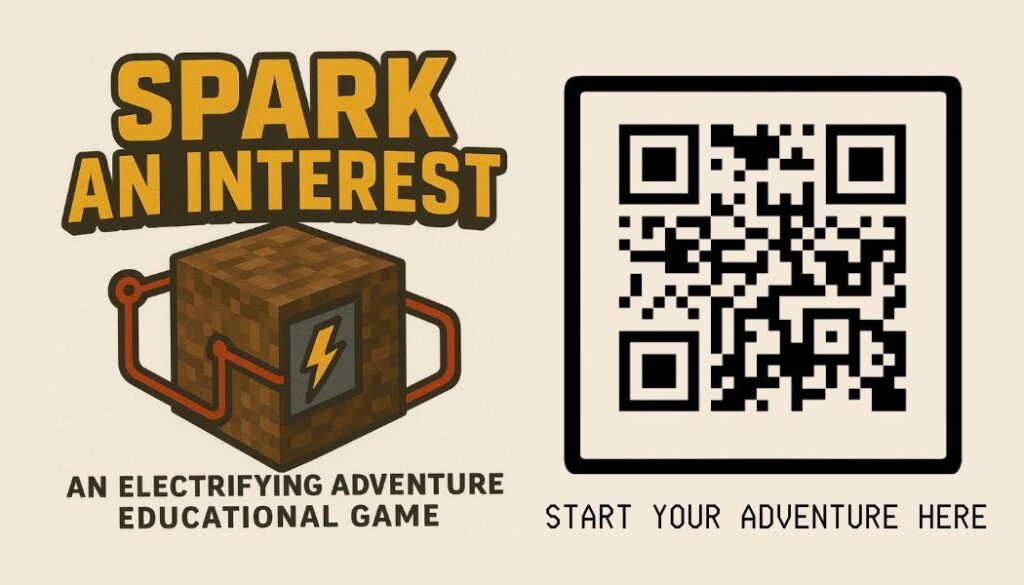
Minecraft: Spark the Trade: a brief description of the created game and how you can think like a future electrician while building your own powered creations. There also are instructions for accessing the game site.
Career Quizzes: Find Your Power Path, BIM Career Quiz, and Choose Your Own Adventure quizzes help visitors discover which career path in the trades matches their strengths, interests, and work styles.

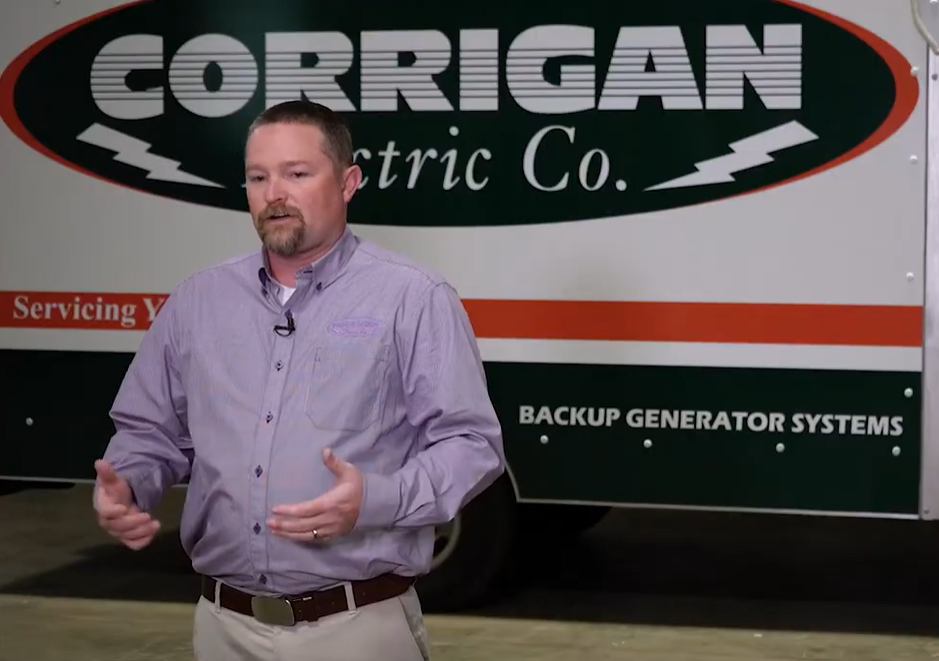
A Day in the Life Videos: videos explore what it’s like to be an apprentice electrician, project manager, electrical construction company owner, and more.
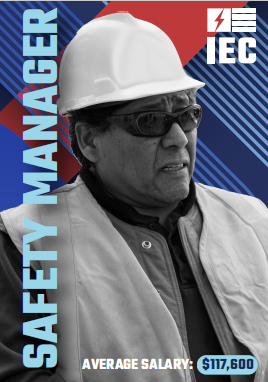
Career Trading Cards: view the training, expectations, and salary ranges for careers within the industry. These cards existed already; the 2025 cohort simply asked if they could be incorporated here.
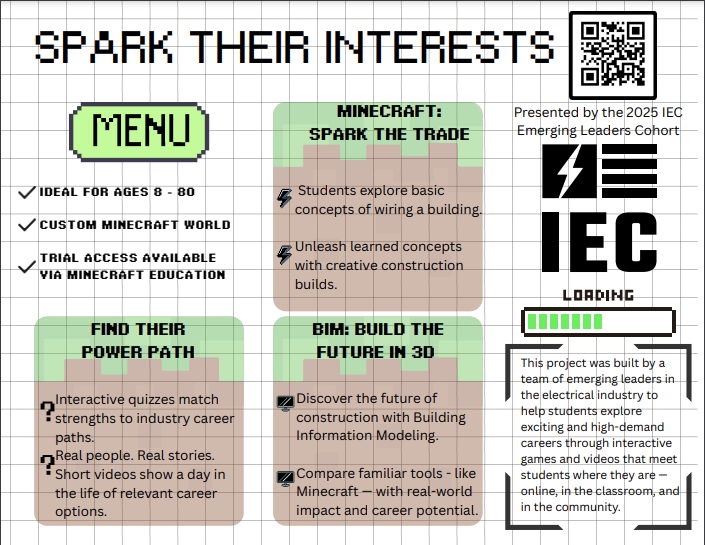
Resources and More Resources: electrical industry description, Building Information Modeling (BIM) details, career traits, lesson plan ideas, infographics, and feedback request.
Getting the Word Out
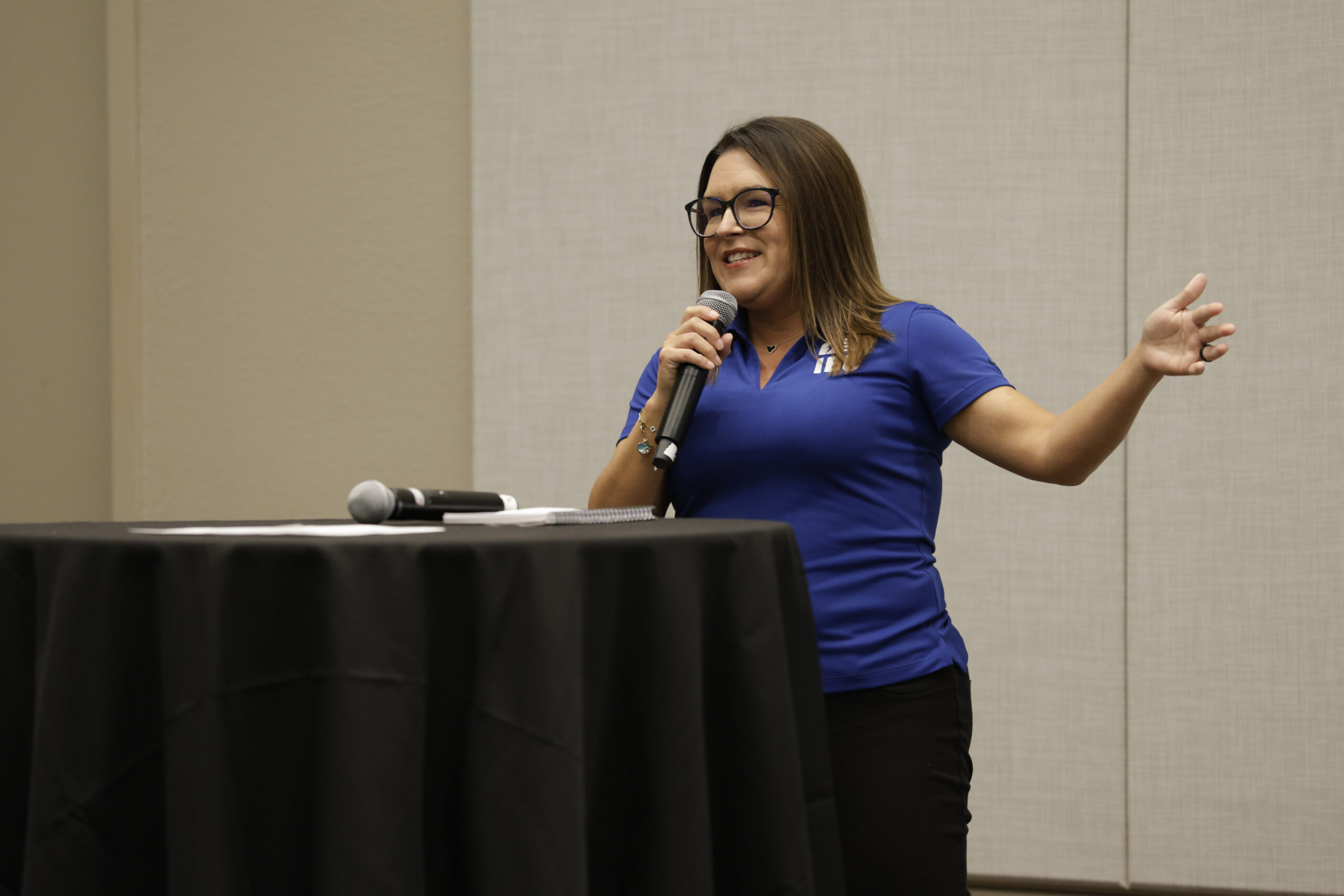
The public launch of the 2025 Emerging Leaders Industry Impact Project was at SPARK in September 2025 in Phoenix. Using some of their newly learned skills from Emerging Leaders educational sessions, the cohort spoke. They felt they had a great project but still there was some apprehension about the how it would be received.
“We each came up, one at a time, to discuss a portion of the project,” Justin shares. “I introduced everybody, and one person spoke about the website, another the day in the life videos, the personality tests, the game. We had a video showing my son playing a portion of the game. We had a full room and people were even standing in the back; they wanted to hear what we had to say.”
There was a lot of buzz about the game before and after the presentation as well.
“I created a QR code and Heather Folsom made business cards and magnets to pass out at SPARK,” CJ says. “I kept going up to people, especially around the Apprentice of the Year competition, to invite them to scan the code to get to the game. We further shared the QR code on social media platforms.”
“We continue to reach out to IEC chapter executive directors to promote our project,” Justin says. “Chapter executive directors do a lot with workforce development by going to schools and trades shows so we want them to know of these resources.”
Next Steps
As the Emerging Leaders program is a short, nine-month program, the cohort took steps to ensure the continuation of their Industry Impact Project after the program’s end in October. They generated a project framework plan and submitted it to IEC National. It was met favorably.
“To ensure the scale up and resource support needed to take the 2025 Emerging Leaders Industry Impact Project to new heights, IEC’s Workforce Development Committee will manage efforts moving forward,” explains Sarah Tiwana, senior manager, IEC Membership Engagement and Content Strategy. “This committee is most closely aligned with aims and objectives of the Industry Impact Project and serves as a natural home for the continuation and maintenance of efforts started by the wonderful 2025 Emerging Leaders cohort.”
Sarah acknowledges the above and beyond effort put forth by the cohort and advises that the Workforce Development Committee has jumped in to carry out its review, evaluation, or operationalization of the recommendations submitted in the framework plan. Also, Heather Creech now serves on the Workforce Development Committee and can consult with her fellow cohort members as the project moves forward.
“The Minecraft seed was more than a game — it was proof that today’s kids are already building, problem-solving, and collaborating in ways that directly translate to the skilled trades,” expresses Heather Creech. “When we pair that mindset with early exposure and hands-on experience, we don’t just create interest — we illuminate a clear, attainable path into our industry. This is how we grow the next generation of builders, technicians, and leaders our workforce depends on.”
Power-Packed People: The 2025 Emerging Leaders Cohort

Caption: Cohort members, left to right: Heather Folsom, Hall Electrical Services, Inc., IEC Dallas; Chester (CJ) Billings Jr., Bausum and Duckett Electric LLC, IEC Chesapeake; Justin Graber, APG Electric, IEC Florida West Coast; Kent D. Joggerst, EcoPower Electric Corporation, IEC Greater St. Louis; Josh Bass, R. K. Bass Electric, Centex IEC; Heather M. Creech, EcoPower Electric Corporation, IEC Greater St. Louis; Marcus Moseman, IEC Fort Worth; Indiana De Los Santos, Atlanta Chapter IEC; Jeremy Starns, Babcon Electric, IEC of the Bluegrass.
Calling All 2026 Emerging Leaders
The Emerging Leaders Program equips participants with practical leadership skills, a deeper understanding of their personal leadership, and strategies to foster collaboration and innovation. Graduates leave confident in their ability to lead, tackle real-world challenges, and contribute meaningfully to the electrical industry. Participants also gain access to an exclusive alumni network that supports ongoing growth and success.
Acceptance into the IEC Emerging Leaders Program is a commitment to personal and professional growth. Participants are required to meet financial and time commitment and cohort and event attendance obligations to ensure a successful and rewarding experience.
You can apply for the program at https://ieci.org/workforce/emerging-leaders. Applications close February 16, 2026.