

The 2026 edition of the National Electrical Code® (NEC®) is the result of more than 4,000 public inputs (formerly called “proposals”) and just fewer than 2,000 public comments. There were hundreds of changes made, and over this year we plan to cover some of the most important ones. Global changes were covered in Insights November/December 2025, Chapter One in January/February, Chapter Two in March/April, Chapter Three in May/June, and Chapter Four in July/August. In this edition of Insights, we focus on a few of the key changes made to
Chapters Five and Six.
547.44 Equipotential Planes
Construction of the equipotential plane is now addressed.
The requirement for an equipotential plane at agricultural facilities is hardly new, yet there have never been specific requirements addressing how they were to be constructed. This section borrows heavily from 680.26, which contains the requirements for the equipotential bonding of swimming pools. Rebar (option one) or welded wire reinforcement (option three) in the concrete slab are the most common methods used, although installing a copper grid (option two) would work just as well. Option four is not exactly an “option” at all, but rather a way to fix the absence of the other three options — very similar to the requirements in 680.26. However, considering that the equipotential plane is only required for concrete floors, it seems the “nonconductive surface” requirement would only apply to a concrete floor that uses epoxy- coated or fiberglass rebar.
The Informational Note that was added to (A) could help clarify which items are likely present in an agricultural facility. This could be useful because it includes nonelectrical equipment that may not seem obvious to someone using the NEC®.
The word “enclosed” was added to (B) but will likely be removed in 2029 as the term “enclosed panelboard” was deleted throughout the NEC® for the 2026 edition.
555.5 Maximum Voltage
The maximum allowable voltage for distribution systems was increased.
For several years, the maximum voltage allowed for pier distribution systems was 1,000V. In the 2020 NEC®, it was determined that this voltage was far too high, so it was reduced to 250V. If the facility could ensure that all servicing of equipment was done by qualified personnel, voltages up to 600V were allowed. This change was extremely problematic for large facilities, as 480V distribution is often necessary, but there is no practical way for many facilities to demonstrate compliance with the engineering-supervision condition. In the 2026 NEC®, these problems were acknowledged and addressed by increasing the permitted voltage to 600V without any additional requirements. This will likely be a welcome change for the design community and particularly for the enforcement community, as determining compliance with the “supervision” caveat formerly found here is quite difficult. It is also interesting to note that proposals to increase the voltage to 25kV have been submitted for the 2029 edition.
555.9 Engineered Design
Most pier distribution systems now require an engineered design.
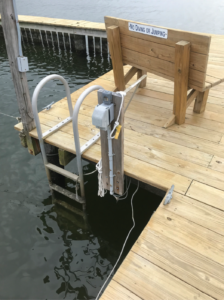
Experienced code users would agree that the requirements in Article 555 have been increasing drastically over the last 20 years, but these changes are almost always warranted and are driven by electric shock drowning concerns. As these systems get more complex, the qualifications of the design professional become more important. New to this edition, most pier distribution systems must be designed by an engineer, and documentation of that design must be provided to the AHJ if they request it. An exception was added for small residential systems where an engineered design is neither necessary nor practical.
555.13 Bonding
The bonding requirements of this article were clarified.
Most of the changes to the section were deletions. The previous language contained a lot of problematic language, such as “all metal parts in contact with water.” Taken literally, that meant every nut, bolt, washer, screw, and any other metal object touching water needed an 8 AWG conductor attached to it. This surely was not the intent, and that language was removed. Gone too is the language about connecting the bonding conductor to “the” panelboard, whichever panelboard that was intended to be. In a small facility, this may have made sense. In a facility with more than one panelboard, it left the reader wondering how to satisfy the requirement. Another change is that the bonding conductor no longer needs to be solid. There are fair arguments for requiring a solid conductor, but that requirement is difficult to justify for a floating dock that moves with tides and waves.
625.43 Disconnecting Means (for EVSE)
The disconnecting means requirements were extensively revised, and an emergency shutoff device is now required for other than one- and two- family dwellings.
As with most utilization equipment, a disconnecting means is required for EVSE and WPTE. The 2023 edition of this section consisted of only three sentences; the 2026 language expands it into five paragraphs.
In multifamily dwellings, a single disconnecting means is sometimes used for multiple pieces of equipment. This practice is still allowed, but marking requirements have been added to (B) to clarify what each switch controls and which EVSE is controlled by a given switch. This correlates with the general requirement of 110.22(A), which mandates that all disconnecting means be marked to indicate their purpose.
Subsection (C) is mainly what previous editions of the NEC® required, although it now puts a limit on when a cord-and-plug connection can be used to satisfy the disconnect requirement. The proposal was to allow any cord-and-plug connection to serve as the required disconnecting means, but the committee statement does not appear to explain why the allowance is limited to 60 amperes and 150V to ground.
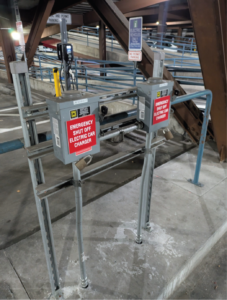
The emergency shutoff requirements in (D) are new to this edition and are intended to provide safety for first responders, such as firefighters. Electric vehicles use lithium-ion batteries, and the dangers of a lithium- ion battery fire are well documented. However, these new requirements will not alleviate that hazard, as the car’s battery is already partially or fully charged. This simply removes the power to the charging equipment.
The proposal for this change indicated that this new language would be in harmony with the requirements of NFPA 30A®, which is for motor fuel dispensing locations. Those rules make sense because shutting off power to the dispensers ensures that gasoline is not fed into an already dangerous situation, such as a car driving into a fuel dispenser. That hazard does not exist with electric vehicles, however, so it is not clear why this rule would need to match NFPA 30A®. However, if a vehicle is on fire and is plugged into an EVSE, it would be beneficial to disconnect it without having to physically unplug it from the vehicle. The requirement makes sense, even if aligning it with NFPA 30A® does not. This new rule might require some ingenuity in design. If there are multiple EVSEs, such as in a parking garage, it might be difficult to place the disconnect within 100 feet of all of them while still being 20 feet away from all of them. Also, note the requirement in (D)(1)(2) that requires the shutoff device to shut down power to all EVSE within sight of the shutoff device. It is not clear if this was intended to mean 50 feet, which is what 110.29 specifies, or if it is intended to mean 100 feet, which is the rule in (D)(1)(1). As written, it seems that 110.29 still applies so the disconnect must shut off all EVSE within 50 feet, not within 100 feet.
695.7 Power Wiring
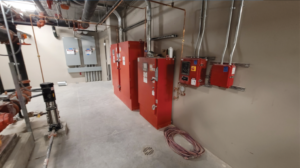
The fire protection requirements for indoor feeder circuits were expanded.
The same change was made to 695.14(F) for control circuits, 700.10(D)(2) for emergency systems, and 708.10(C)(2) for critical operations power systems.
The use of concrete encasement for fire protection of indoor feeder circuits goes back several years, although prior to the 2017 NEC®, there was never a specific requirement indicating how long the concrete needed to protect the contained wiring. It was always assumed that whatever protection 2 inches of concrete provided was “good enough,” but a two-hour minimum requirement was added in the 2017 NEC®. This put the validity of the concrete encasement into question. Does 2 inches of concrete encasement really provide two hours of fire protection for the conductors within? Recent testing has shown that it probably does not. An engineer who is familiar with fire-resistance ratings could document that their design provides two hours of protection with 2 inches of encasement based on the specific concrete mix and other applicable variables. The more likely approach, however, is that an engineer will follow
The new requirement for emergency shutoff devices will likely be satisfied by installing switches like these. In a parking garage like this one, it will require careful planning to ensure the device is more than 20 feet from the EVSE but within 100 feet of it.
the prescriptive rule that now requires 5 inches of encasement, as opposed to 2 inches.
 Ryan Jackson is a textbook author and instructor in Salt Lake City, teaching the NEC® countrywide for three decades. His textbooks are used throughout the IEC Apprenticeship Program. Ryan serves on NEC® Code-Making Panels 3 and 17 and several technical committees for UL Standards and Engagement. He also is a technical consultant for the Steel Tube Institute and has worked as an expert witness on several NEC®-related legal matters.
A Complete Guide to the 2026 NEC® Changes by Ryan Jackson is available for purchase through the IEC Training Advantage bookstore at iectraining.com.