
The 2026 edition of the National Electrical Code® (NEC®) is the result of more than 4,000 public inputs (formerly called “proposals”) and just fewer than 2,000 public comments. There were hundreds of changes made, and over this year we plan to cover some of the most important ones. Global changes were covered in Insights November / December 2025 and Chapter One in January / February.
In this edition of Insights, we focus on a few of the key changes made to Chapter Two.
210.8 Ground-Fault Circuit-Interrupter (GFCI) Protection for Personnel
Clarifications and editorial revisions were made, and the rules for HVAC equipment were revised to expand the ampere rating and to reduce the protection requirements.
For the first time in more than 30 years, the GFCI requirements in this section were not expanded in any significant way. Although there were not any sweeping changes to 210.8, the changes in GFCI technology are worth discussing.
Two new Informational Notes were added to inform the reader of the changes taking place with GFCI devices. Type GFCI-HF (GFCI high frequency) is expected to be available sometime in the very near future. Although the 2026 NEC® discusses GFCI-HF+, that technology was not added to the UL product safety standard and may not be for some time.
Over the last several years there has been much discussion about unwanted tripping of GFCIs on circuits supplying appliances. These appliances vary from HVAC equipment to refrigerators and other appliances. The reason for these unwanted trips is the existence of high frequency leakage current. Many modern appliances employ variable speed motors supplied by internal adjustable speed drives, such as variable frequency drives (VFDs). On high frequencies (above 10,000 hertz), there is often a small amount of leakage current that exceeds what would be allowed on a GFCI device. A GFCI device works by measuring the current on the circuit conductors and ensuring that there is no current unaccounted for. For example, if a two-wire circuit pulls 10A, there should be 10A on the ungrounded conductor and 10A on the neutral conductor. If there was 10.1A on the ungrounded conductor and 10.0A on the neutral, that would mean there is 0.1A somewhere that it is not supposed to be, such as flowing through a human. This is often known as “leakage current” or “ground fault current,” although “differential current” may be the most accurate term.
The Class A GFCIs that are used today must not open at differential current less than 4 milliamperes (mA) or 0.004A and must open at differential current exceeding 6 mA or 0.006A. These values are sometimes called the “green zone” for less than 4mA, the “yellow zone” for 4-6mA, and the “red zone” for greater than 6mA (more on this below). These are based on research carried out in the 1940s and ‘50s by Dr. Charles Dalziel and that research is still used today. The severity of an electric shock depends not only on the current going through the victim but also the path it takes (e.g., hand-to-hand or hand-to-foot), the duration of the shock, and the frequency of the circuit.
Initially there was little research about the effects of high frequency electric shock on humans. By the time the research was needed, we could no longer shock a bunch of college students like Dr. Dalziel did 70 years ago. But later research by Dr. Dalziel and newer research published by the International Electrotechnical Commission (IEC) show that the severity of a shock decreases as the frequency increases.
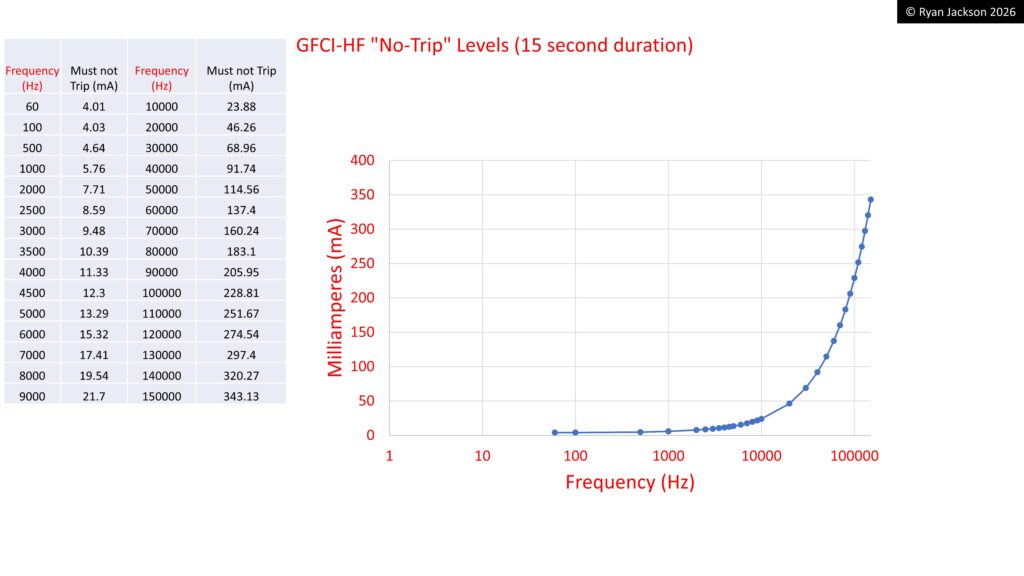
Modern appliances with variable frequency drives can reach frequencies of up to 150 kHz (150,000 hertz). If the GFCI opens at 6 mA on such a frequency, it has opened during a condition that is not unsafe. Because of Department of Energy regulations, appliance manufacturers will continue to use VFDs in their design and their usage will likely increase significantly over the next several years. With this in mind, a more modern GFCI device is needed to protect at 4-6mA at low frequencies and at a higher mA value for higher frequencies. This is where the GFCI-HF and GFCI-HF+ come into the discussion. The product safety standard for GFCIs (UL 943) was revised in late 2025, and the GFCI-HF devices are expected soon. Both HF and HF+ move the green zone value discussed earlier. The HF+ also moves the red zone, but this technology was not accepted in the standard. The GFCI-HF uses a curve that changes the green zone, allowing far more leakage current for high frequencies.
The 2020 NEC® added 210.8(F) for outdoor outlets and the GFCI discussion has not been the same since. This is where the world’s eyes were opened to the problems associated with GFCIs on variable speed motors. Multiple proposals have been made and multiple Tentative Interim Amendments have been issued to resolve the problems created by this requirement. In a rather surprising move, the GFCI requirement was increased to include 60A circuits, not just 50A and lower. Although it surprised many to see an increase in this requirement considering the well-known incompatibility issue, a third exception was added to allow special purpose ground fault circuit interrupter (SPGFCI) protection for listed HVAC equipment instead of GFCI protection. An SPGFCI does not open until a differential current of more than 20mA is present. If such a device is used, a warning label must be placed on the disconnecting means to indicate that the protective device is not the Class A type that is to be expected after the deadline in Exception 2 expires. This may become moot, however, as the GFCI-HF is expected to be available before the expiration date of the second exception. This would likely be a more viable option than SPGFCI protection.
210.52 Dwelling Unit Receptacle Outlets
The issue of receptacles below kitchen countertops and work surfaces was clarified.
Perhaps the most discussed 2023 NEC® code change was regarding dwelling unit kitchen island and peninsula countertops. The 2023 edition removed the longstanding requirement of installing a receptacle for kitchen islands and peninsulas and prohibited receptacles from being installed beneath the countertop — sort of. In actuality, receptacles were still allowed beneath a countertop because installing a cord-and-plug connected in-sink disposer would have been impossible otherwise. The rule instead indicated that receptacles for the countertop could not be installed beneath the countertop — sort of. That too was debatable.
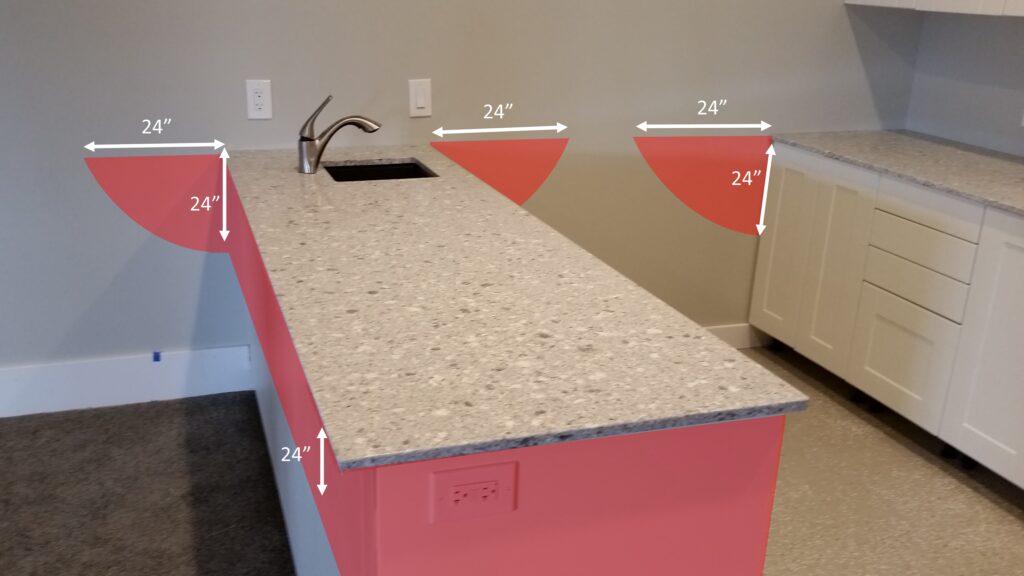
Now the rules are clearer, although you will need to read them several times to get the full picture. The intent is that receptacles should not be beneath the countertop because people can accidentally (or in the case of young children, intentionally) pull the cord and drop an appliance full of boiling water or oil onto themselves. Data provided by the U.S. Consumer Product Safety Commission showed that this type of injury (and even death) is far more common than one might think. The hazard does not exist, however, if the receptacle is beneath the countertop but close to the floor. Revisions in the 2026 NEC® clarify that receptacles beneath the countertop must be at least 24” below the countertop, otherwise the hazard still exists. Receptacles in drawers also are allowed, but do not count as a required receptacle [210.52(3)].
210.63 Equipment Requiring Servicing
The requirement for a receptacle near electrical equipment was simplified.
Although 210.63 has been in the code for decades, 210.63(B) is still relatively new. As such, it has taken a few years to get it right. That is understandable as writing concise, easy-to-understand, and enforceable code is harder than many realize. Changes to this section include removing the language about the load side of a disconnecting means because it resulted in installations nearly impossible to make compliant. Additionally, the rule now only applies if the installation includes a system with a voltage of 150V or less. Previous versions required a 120V receptacle even if the building only had 277/480V in it, resulting in more installations that could not realistically comply. The rule also was simplified by changing three subsections into two sentences.
225.31 Disconnecting Means
The building disconnecting means no longer needs to be in or on the building.
This section has long required buildings supplied by a feeder or branch circuit to have a disconnecting means that is (typically) on or inside the building served. But recent changes to the NEC® have highlighted some flaws with that requirement. The 2023 NEC® added Section 225.41 to correlate with the emergency disconnect (formerly) required in 230.85. Section 230.85 required one- and two-family dwellings to have a way to allow first responders, mainly firefighters, to have a way to shut off the power to a dwelling without having to resort to dangerous practices, such as pulling out the utility meter while it was under load.
Section 225.41 recognizes that not every dwelling has the service equipment hanging on the exterior wall. Sometimes the service equipment is 100 feet (or more) from the house, meaning the house is supplied by a feeder circuit and not a service. Section 225.41 was added to ensure that firefighters can shut off power to the one- or two-family dwelling, regardless of whether it is supplied directly by a service or from a feeder. The emergency disconnect for the dwelling does not need to be on the dwelling. As long as it is within sight, it is “safe enough.” Why must the building disconnect required by this section (225.31) be either on or within the building if “within sight” is safe enough for applications covered by 225.41? Revisions to 225.31(A) and (B) were made to address this logical fallacy.
230.2 Listing Requirements
Absence of voltage testers were added to Article 230.
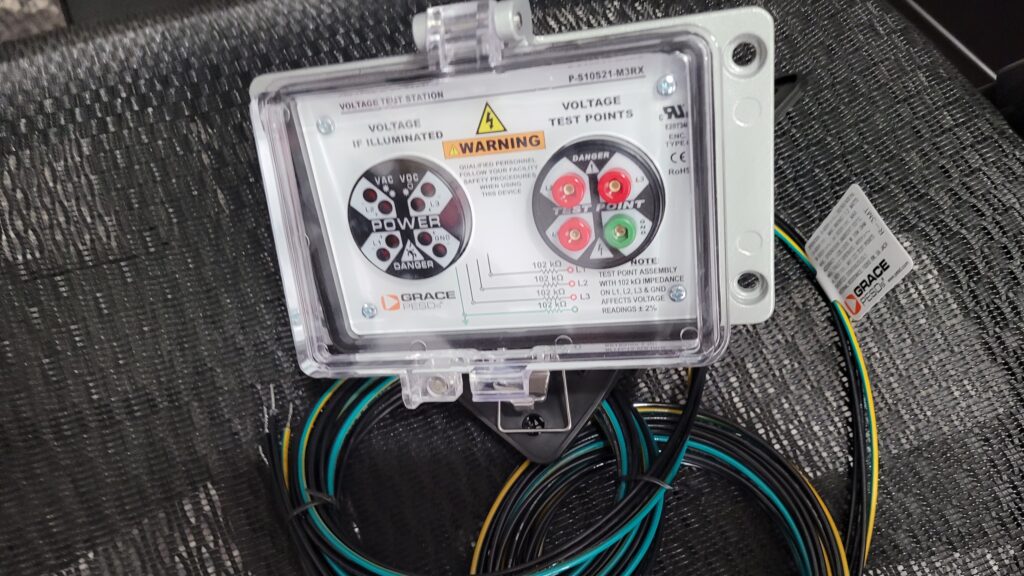
A permanently installed absence of voltage tester is not something you see every day, and it was not mentioned in the NEC® until now. In large commercial and industrial facilities, the voltage, available fault current, and (often intentionally) long opening times of some overcurrent protection devices (OCPDs) can result in extremely dangerous situations for those that have to work on equipment. There are plenty of scenarios where the incident energy of an arc flash is greater than commercially available PPE will protect against. It is easy enough to say, “don’t work on that equipment if it is energized,” but remember that verifying the absence of voltage is energized work.
According to NFPA 70E®, an electrically safe work condition does not exist until all the required steps have been taken, which includes verifying the absence of voltage. So, what kind of PPE do you wear to verify the absence of voltage when an arc flash’s incident energy is too great for any PPE? There is no perfect answer to that question. One way to greatly improve safety is to install a permanently mounted absence of voltage tester on the door of the equipment. These devices have various features, but most typically have LEDs to show whether the equipment is on or off, and have test points for the electrician to put his or her test leads in to verify. This means the electrician can perform the testing without being exposed to a risk that even the best PPE will not protect against.
230.67 Surge Protection
The locations requiring surge protection were increased and the exception was clarified.
The requirements for surge protection are to provide overvoltage protection for locations that use sensitive electronic equipment, such as GFCIs, AFCIs, smoke alarms, and home medical equipment. Because AFCIs are required in the locations indicated in the new item (5), surge protection is now required as well. These include the sleeping rooms of fire, police, ranger, and ambulance stations.
The exception in 230.67(B) has been the cause of many disagreements in the field, mainly due to the use of the undefined term “distribution equipment.” If the service equipment supplies only feeder circuits, installing an SPD at the end of those feeder circuits satisfies the requirement of having an SPD at the service itself. With the requirements in 215.15 in mind, this is quite often the case. But if the service equipment supplies branch circuits, such as a panelboard that has a 100A service disconnect and provisions for 20 or so circuit breakers, an SPD would be required at the service and at the load side of any feeders leaving it.
230.70 General
The service equipment for one- and two-family dwellings now must be outdoors. Some editorial revisions and clarifications also were made.
At first glance, it appears that this entire section was either rewritten or is totally new, but very little has changed. The requirement for an emergency disconnect for one- and two-family dwellings was added in 230.85 of the 2020 NEC®. It received a handful of small revisions in the 2023 edition, including signage requirements. The biggest topic regarding the emergency disconnect requirement always has been the list of (seemingly absurd) options for how to comply. If a person put a disconnect on the outside of their house, they could still put the service disconnect on the inside by simply putting a sticker on the outside disconnect that indicated that the outdoor disconnect was not really a service disconnect; it just looked and acted like one. Putting a sticker on a switch does not change the definition of service equipment. The service equipment is where you shut off the utility — sticker or no sticker. There also was an option for a meter disconnect switch, but even code experts disagreed on what that piece of equipment actually was. Searching online for a “meter disconnect” yields a variety of contradicting results.
New to this edition, 230.85 was deleted and many of its former requirements were relocated to 230.70, with one key difference: The service disconnect must be outdoors for one- and two-family dwellings. No more stickers and no more meter disconnects.
About the Author

Ryan Jackson is a textbook author and instructor in Salt Lake City, UT, teaching the NEC® countrywide for three decades. His textbooks are used throughout the IEC Apprenticeship Program. Ryan serves on NEC® Code-Making Panels 3 and 17 and several technical committees for UL Standards and Engagement. He also is a technical consultant for the Steel Tube Institute and has worked as an expert witness on several NEC®-related legal matters.
A Complete Guide to the 2026 NEC® Changes by Ryan Jackson is available for purchase. Buy your copy through the IEC Training Advantage bookstore at iectraining.com.