
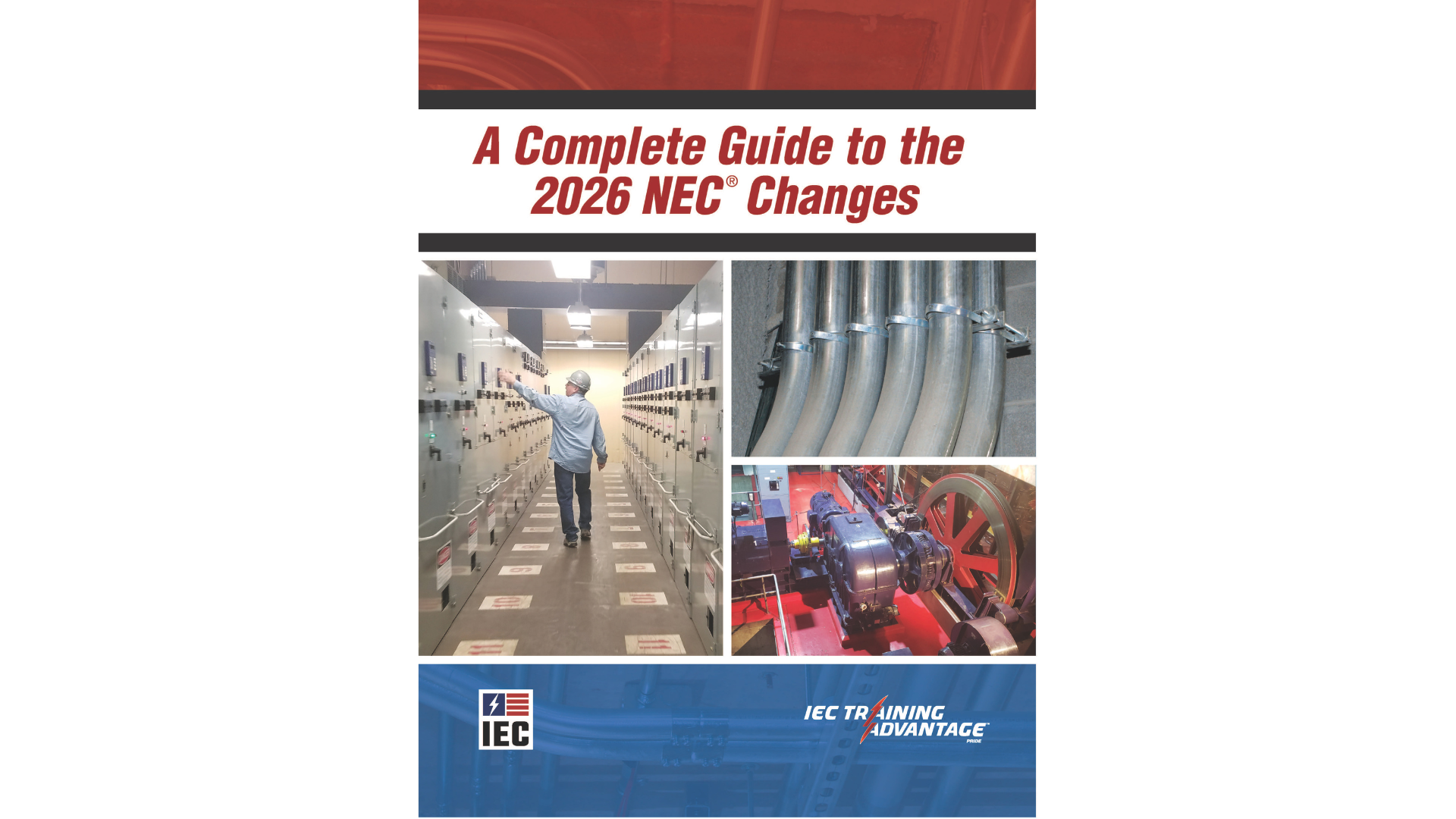
The 2026 edition of the National Electrical Code® (NEC®) is the result of more than 4,000 public inputs (formerly called “proposals”) and just fewer than 2,000 public comments. There were hundreds of changes made, and over this year we plan to cover some of the most important ones. In this edition of Insights, we focus on a few of the key changes made to Chapter Four.
Global changes were covered in Insights November / December 2025, Chapter One in January / February, Chapter Two in March / April, and Chapter Three in May / June.
In this edition of Insights, we focus on a few of the key changes made to Chapter Four.
406.14 Mounting of Receptacles
Receptacles in laundry areas must not be installed facing upward.
Installing an upward facing receptacle has some obvious hazards. In countertops and work surfaces, these hazards are alleviated by using a specially designed device that is tested and listed for those applications. Installing an upward facing receptacle beneath a sink is never a good idea and is prohibited regardless of receptacle type. New to this edition, installing an upward facing receptacle in a laundry area is now a violation. The countertops and work surfaces within a laundry area were already addressed, so what does this new requirement really do? It seems that a floor receptacle is no longer allowed anywhere in a laundry area. A floor receptacle in the middle of a laundry room is certainly not a common sight, but what about a surface mount 250V, 30A receptacle on the floor near the dryer? That practice is no longer permitted.
Section 406.14 also received many editorial revisions that did not yield any technical changes.
406.26 Tamper-Resistant Receptacles
Receptacles in park and recreation areas now must be tamper resistant.
Tamper-resistant receptacles have been in the NEC® since 2008 and were added as a result of an alarming number of injuries. Originally, they were required in dwelling units only, but the locations requiring the protection have ballooned since then. New to this edition of the code, park and recreation areas now require tamper-resistant receptacles as well. Children are likely to be unsupervised in these locations, and although there was no real technical substantiation to add these locations, it makes as much sense as the other locations in this section, such as agricultural facilities and skating rinks.
The exception and the other ten locations covered in this section were not changed in any substantive way.
408.6 Short-Circuit Current Rating
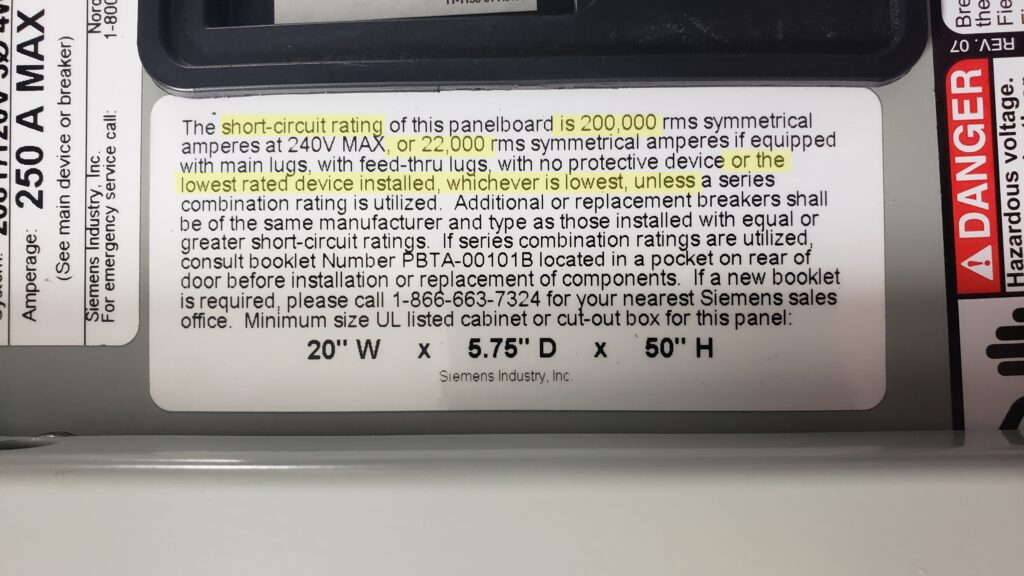
The marking requirements for switchboards, switchgear, and panelboards were greatly expanded.
Although this section went from a small paragraph in 2023 to this rather large list in 2026, the ramifications are not as big as they initially seem. The general requirements of 110.9 and 110.10 already require what most of this change is intended to capture. All equipment must be rated for the available fault current, which is typically ensured by its short-circuit current rating (SCCR) being equal to or greater than the available fault current. However, the short-circuit current rating of the equipment covered in this article is not necessarily a static number like it is for a “simple” piece of equipment like a non-fusible general use switch used as a motor disconnect. Consider a panelboard that has a short-circuit current rating of 22,000A, for example. If the available fault current is only 8,000A, the panelboard will likely have circuit breakers with a 10,000A interrupting rating. Due to this, the panelboard’s SCCR is no longer 22k, it is 10k. New to this edition of the code, that new value must now be written on the panelboard. Why this is needed is a bit vague, however, because it is already written on the panelboard by the manufacturer. Additionally, if the circuit breakers are all properly rated, as required by 110.9, and the panelboard is properly rated, as required by 110.10, why would it need to be remarked?
The remainder of this section is important but also perhaps unnecessary as well. If changes to the system occur that change the available fault current, and if that resultant change makes the installation noncompliant, something must change. That is true with or without the words of this section, but perhaps by adding them here it will remind people of the importance of this requirement.
422.12 Central Heating Equipment
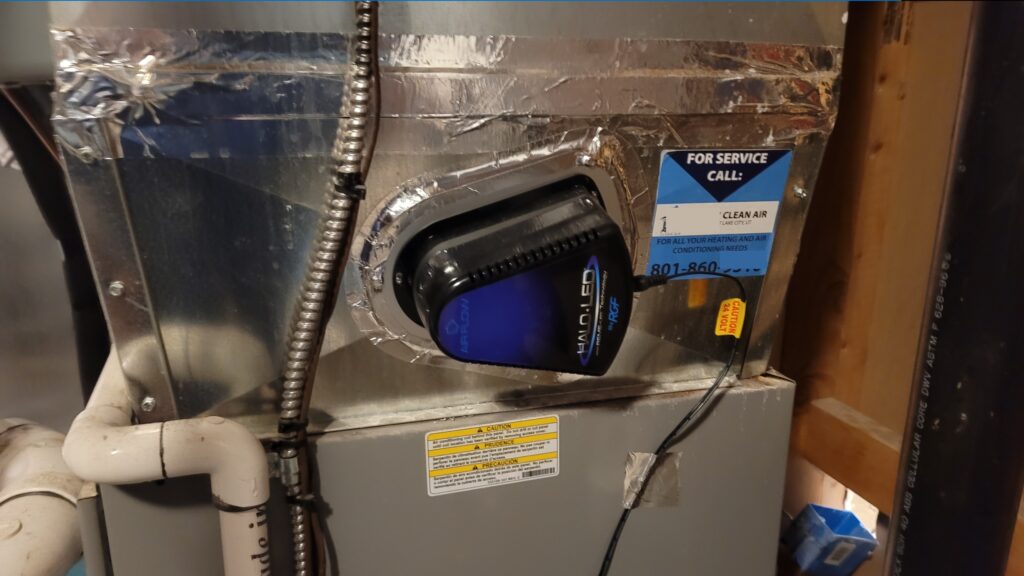
The types of equipment allowed on the central heating branch circuit were expanded.
In many parts of the country, central heating equipment is a life-safety piece of equipment. For this reason, the NEC® does not allow other equipment on that circuit. Auxiliary equipment for the central heating appliance is allowed by Exception 1. Auxiliary equipment could include air cleaners and humidifiers, but now commonly includes germicidal irradiation luminaires as well. These luminaires are typically installed inside of the furnace’s plenum and cycle on and off to kill germs within the air-handling system. Instead of adding these special luminaires to the list of permitted items, the Code-Making Panel decided to use the catch-all term “similar” to avoid inadvertently limiting the user by not including every type of equipment that could be considered auxiliary to the appliance.
The second exception was also expanded to allow the lighting required by 210.70(A) and the receptacle required by 210.63(A). The lighting and receptacle are both necessary to aid in maintenance or repair of the appliance. The lighting outlet does not draw much in terms of current, and the receptacle is likely to be used only for diagnostic equipment. As such, the total load is miniscule and is now allowed on the circuit. If one were to plug in a power tool, which consumes more power, to work on the equipment, one would hope that the appliance was de-energized, hence the new allowance.
426.60 General
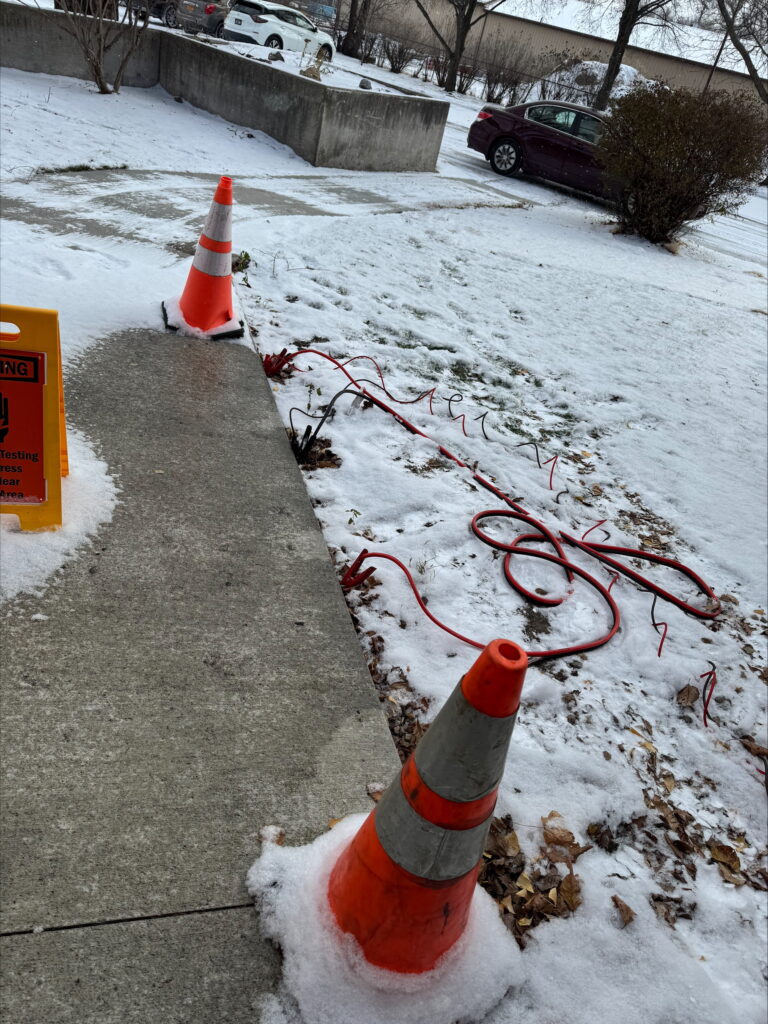
Conductive pavement heating systems were added to Article 426 in the new Part VI.
A new Part VI was added to Article 426, which consists of 426.60 through 426.88. These systems use conductive paving material, such as concrete with embedded carbon fibers. Inside this paving material, electrodes, such as stainless steel rods, are placed at specific spacings. The electrodes are then energized at a voltage of up to 30V ac or 60V dc. This heats the pavement and melts any accumulated snow or ice.
Intentionally energizing a surface that people and other animals will be walking on has some obvious inherent safety concerns, but the requirements in this new Part of Article 426 are very broad and very stringent. One of the main reasons this material was added is because there were no existing limitations on devising such a system under the previous versions of the code — and people have been doing just that. The submitter of this concept had made the Code-Making Panel aware of “do it yourself” systems, including energizing concrete to 480V and putting no actual safety measures in place.
There are several unique requirements for these systems, including the design and oversight of both an electrical engineer and a civil engineer. As indicated in 426.2, these systems must be listed as a system. A hodgepodge of various equipment, even if listed, is not permitted for these applications. As of this writing, a product safety standard or outline of investigation does not yet exist but is currently under development. This means they will not be available immediately. These systems must also have a site-specific design, so do not look to buy one from your local hardware store. (Even if you could, you still need to have both engineers supervise the installation.)
Notably absent from the requirements is any sort of GFCI or even GFPE protection. That was intentional because that type of protective system will not function in these applications. Instead, lower voltages and an isolating, ungrounded power supply are used, much like some swimming pool lighting systems and the operating rooms of many hospitals.
Refer to the NEC® for the full requirements for these systems, as there are many.
430.7 Markings on Motors
Two new motor design types were added throughout Article 430.
The motor design types indicated in this section allow the specifier or installer to ascertain a lot of information quickly if they are familiar with the design types. For example, if a person needs to buy a motor that is under load the second it starts (like a crane or a hoist), they will likely want a motor that is marked “Design D.” For an HVAC application, a “Design B” may be more appropriate. Two new motor design types were added in the 2026 NEC®, both in response to the Department of Energy’s requirements for energy efficiency. It is important to note that, as of this writing, these motor types are still under development and there is very little in the way of technical information about them. This technology, and the associated requirements, are sure to evolve over the next few years.
Multiple changes were made throughout Article 430 for these new motors, including a new 430.22(H) and Table 430.251(C). One of the key differences with these new motors is the locked-rotor current, hence the new Table 430.251(C). When the motor is running, the current is not much different than an ordinary motor. Under locked rotor conditions (startup), however, the current is much greater than shown in Table 430.251(B) which is why the new Table 430.251(C) was added.
Section 430.22(H) was added to give specific requirements for conductor sizing. If the motor is used in a continuous duty application, the conductors are sized at 125% of the motor’s FLC rating, just like a typical motor. If they are used in a different manner, such as intermittent, varying, or short time duties, 430.22(E) applies, just like a typical motor. But due to the very high inrush current (locked rotor), special requirements are needed to keep the conductors from experiencing excessive temperatures. The type of conductor medium (copper versus aluminum) as well as the insulation type (thermoset versus thermoplastic) need to be considered, as does the duration that the conductors are exposed to the starting current. Protection from excessive heat can be achieved by employing an adjustable speed drive system, a reduced startup voltage, or a wye-start delta-run configuration. If none of those are used, the equation in 430.22(H)(3) will need to be used. As that section’s new Informational Note indicates, the equation could result in larger conductors than would otherwise be required.
Exception 4 to 430.24 provides a similar requirement for conductors serving multiple motors, one or more of which is Design BE or CE.
Table 430.52(C)(1) was also revised to include these new motor types. These motors are lumped in with Design B energy-efficient and Design B premium efficient motors. When using a fuse or inverse time circuit breaker, the ground-fault and short-circuit protective device ratings are still the same as most other motors. However, if an instantaneous trip breaker (aka motor-circuit protector or magnetic only) is used in conjunction with a listed combination motor controller, the maximum rating can be 1,100% of the FLC instead of the standard 800% for other motors using the same protective device. The “failure to start” exception in that section also allows a whopping 1,700% maximum if the table values will not allow the motor to start [430.52(C)(3)(b)(2)]. Considering that the main concern with these motors is startup current, that allowance might prove necessary.
430.98 Marking
Motor control centers must now be marked to indicate their disconnecting means.
Just like a panelboard, switchboard, or switchgear, a motor control center sometimes requires maintenance, repair, or alterations that require their power supply to be turned off. Just like 408.4(B) for panelboards, switchboards, and switchgear, this section now requires the equipment to be marked to inform the electrician where they need to go to disconnect the power.
430.132 GFCI and SPGFCI Between Motor and Power Conversion Equipment
A new section was added to address GFCIs and SPGFCIs between the motor and the power conversion equipment.
The output voltage of an adjustable speed drive, such as a variable frequency drive (VFD), can be as much as 1.6 times the input voltage (e.g., a 120V input circuit for a VFD can result in 192V on the output circuit). When used with a variable speed motor this is not concerning as the motor is designed for this application. But what if a GFCI device is installed downstream of a VFD? A GFCI is not designed for that kind of increased voltage. This means the GFCI could be the source of an imminent fire and electric shock hazard. Due to this, the GFCI or SPGFCI must never be installed on the load-side of a VFD.
440.15 Split-System Disconnect Identification
New marking requirements were added for split-system HVAC installations.
As indicated in 440.8, a split-system HVAC setup is considered a single machine, so only one disconnecting means is required for the multiple components of the installation. That disconnecting means is typically located outdoors in order to satisfy 440.14. However, if there are multiple split-systems installed at the same building, an electrician or HVAC technician may need to work on the inside portion of the installation, and they need to know which disconnecting means controls the equipment they are going to service. This is already required by 110.22(A) but is often overlooked.

Part I General
495.2 Listing Requirements
New listing requirements were added for equipment exceeding 1,000V.
Few would argue against the need for listed equipment, especially equipment like medium voltage switchgear, but most equipment used at these voltage levels are not listed. Why? Because there was no requirement for it. A manufacturer is not likely going to go through the expense of having their product listed if their competitor does not do it as well. Product safety standards for these types of equipment do exist and getting listed equipment is currently possible. However, manufacturers that have not had their equipment listed need time to do so. Additionally, suppliers and contractors need time to use up their existing inventory, hence the future effective dates for both of these requirements.
About the Author

Ryan Jackson is a textbook author and instructor in Salt Lake City, UT, teaching the NEC® countrywide for three decades. His textbooks are used throughout the IEC Apprenticeship Program. Ryan serves on NEC® Code-Making Panels 3 and 17 and several technical committees for UL Standards and Engagement. He also is a technical consultant for the Steel Tube Institute and has worked as an expert witness on several NEC®-related legal matters.
A Complete Guide to the 2026 NEC® Changes by Ryan Jackson is available for purchase through the IEC Training Advantage bookstore at iectraining.com.